
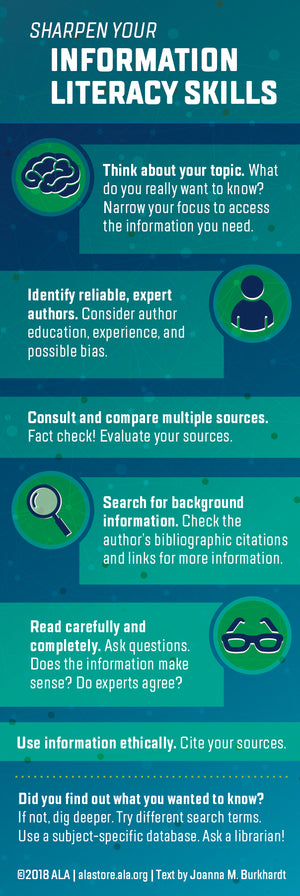
Photo credit: ALA.Marketplace, Information Literacy Bookmark. Created by author Joanna M. Burkhardt, professor and head librarian at the University of Rhode Island (URI) branch libraries

Find your keywords for your research topic. Be sure to use commands, And, or Not Operators, to further specify your search.
What is Information Literacy? The ability to recognize when information is needed, identify, locate, evaluate, and effectively use and share it responsibly for the problem at hand. (Adopted from the National Forum on Information Literacy)
If we don't have an item here at Berry Library you can request it through Interlibrary Loan (ILL). This means we will look to see if another library has the item and if we can borrow it from them. If we can borrow it you will get an email when the item arrives here at the Library. To request an item through ILL, find it in the catalog and click on the blue Request button.

To find out more about Interlibrary Loan see our Guide.

 Librarian Tip: You can search the catalog for a variety of items (articles, books, DVDs, and more). Looking for a specific article? Just search for the title of it in the catalog, just like you would for a book or DVD.
This course is taught by Professor Suzanne Yakes.
The steps for developing a research question, listed below, can help you organize your thoughts.
Step 1: Pick a topic (or consider the one assigned to you).
Step 2: Write a narrower/smaller topic that is related to the first.
Step 3: List some potential questions that could logically be asked about the narrow topic.
Step 4: Pick the question that you are most interested in.
Step 5: Change the question you’re interested in so that it is more focused and specific.
| Type of Question | Description | Example |
|---|---|---|
| Closed-ended | Can be answered with yes/no or a single fact. | Do bilingual teachers use Spanish in the classroom? |
| Open-ended | Invites explanation, analysis, or storytelling. | How do bilingual teachers use Spanish to support cultural identity in the classroom? |
Closed-ended:
Do early childhood educators use culturally relevant materials in their classrooms?
→ Can be answered with a yes/no or a statistic.
Open-ended:
How do early childhood educators incorporate their cultural identities into classroom practices in multilingual settings?
→ Invites exploration of strategies, experiences, and challenges.
Topics:
First Drafts of Research Questions:
Some answers to the “Focusing Questions” Activity above are:
Question 1: Why have most electric car company start-ups failed?
Vagueness: Which companies are we talking about? Worldwide or in a particular country?
Question 2: How do crabapple trees develop buds?
Vagueness: There are several kinds of crabapples. Should we talk only about one type? Does it matter where the crabapple tree lives?
Question 3: How has NASA helped America?
Vagueness: NASA has had many projects. Should we focus on one project they completed? Or projects during a particular period?
A prompt is (technically speaking) input to an AI tool. For research AI tools, the prompt is almost always a question, request, or topic posed by you, the human researcher. Why should you try to write good prompts?

Search for resources using our Library home page.
